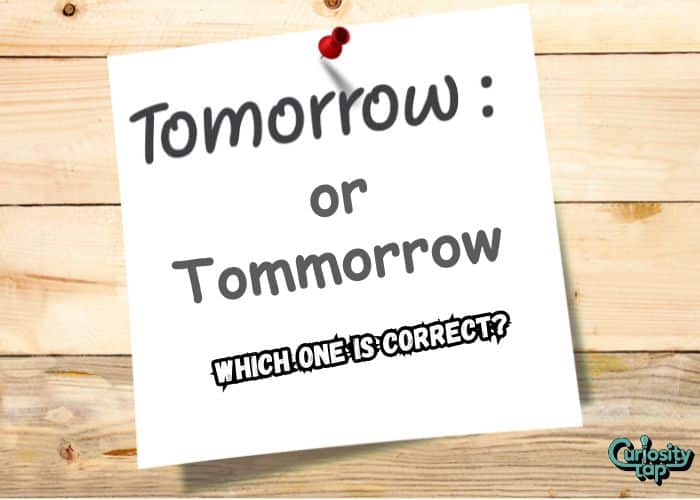
Ever written “tommorrow” in a hurry, only to be flagged by autocorrect? You’re not alone. Spelling errors can be subtle yet embarrassing especially with common words like this.
Whether you’re a student polishing an essay or a professional crafting an email, using correct English spelling is crucial for credibility.
In this article, we’ll clear the confusion around tomorrow vs tommorrow, explain why one is right and the other isn’t, and equip you with tools and tips to remember the correct spelling every time. Let’s get to the bottom of it once and for all.
Why This Confusion Happens: Double Letters Are Often the Culprit
Words like “accommodation,” “occasionally,” and “recommend” confuse many because of their double letters. The mistake with tommorrow arises from a similar assumption: that there should be two m’s but that’s not the case.
Autocorrect Can Help Or Hurt
While smartphones and grammar tools often catch the mistake, they can also teach bad habits. Over-relying on them means you might not learn the correct form by heart, which can cause issues in handwritten or offline contexts.
The Origin and Meaning of A Word from Middle English
The word stems from Middle English tomorwe, a contraction of “to morrow,” literally meaning “on the morrow” or the next day (Oxford English Dictionary).
Modern-Day Usage
In today’s English, tomorrow is used both as a noun and an adverb:
- Noun: “Tomorrow is a holiday.”
- Adverb: “We’ll meet tomorrow.”
Its ubiquity in daily communication makes correct spelling all the more important.
Real-Life Example: Why Spelling Matters
✍️ Case Study: The Job Application That Got Rejected
In 2023, a college graduate submitted an otherwise strong cover letter to a marketing firm. However, the phrase “I’ll follow up tommorrow” was flagged by the hiring manager. The typo, though minor, led them to question the candidate’s attention to detail ultimately contributing to their rejection.
This small slip cost them a big opportunity. It’s a powerful reminder: spelling matters more than we think, especially in formal contexts.
How to Remember the Correct Spelling of “Tomorrow”
| Memory Trick | How It Helps |
|---|---|
| “To + morrow = tomorrow” | Think of it as two words: to + morrow |
| Only one “M” | Say: “Tomorrow has one M, not two” |
| Practice typing it daily | Builds muscle memory |
| Use mnemonic: “Today, ToMorrow, always 1 M” | Reinforces spelling rule |
Tomorrow or Tommorrow: A Quick Comparison
| Version | Spelling | Correct? | Used In |
|---|---|---|---|
| Tomorrow | t-o-m-o-r-r-o-w | ✅ Yes | Formal, Academic, Everyday English |
| Tommorrow | t-o-m-m-o-r-r-o-w | ❌ No | Common mistake, informal messages |
FAQs: People Also Ask
What is the correct spelling: Tomorrow or Tommorrow?
The correct spelling is tomorrow with only one “m.”
Why do people spell wrong with two M’s?
Because similar words contain double letters, people assume it follows the same pattern. But it doesn’t.
Is “tommorrow” accepted in informal writing?
No, it is always incorrect, regardless of formality.
How can I teach kids the correct spelling of tomorrow?
Use phonics-based games, flashcards, or rhymes like: “T-O, M-O-R-R, O-W—tomorrow is just one day away!”
Is “tommorow” a British spelling?
No. Both American and British English use the right spelling.
Pros & Cons of Using Spellcheck for Words Like “Tomorrow”
| Pros | Cons |
|---|---|
| Catches common mistakes instantly | Can create dependency |
| Enhances professional communication | Doesn’t teach the logic or origin of words |
| Saves time while writing | May autocorrect incorrectly in rare cases |
Conclusion: Make Tomorrow Error-Free
Spelling mistakes like tommorrow may seem minor but can affect your credibility. The correct spelling tomorrow has only one “m” and is widely used in both speech and writing. With the memory tricks and context we shared, you can now spell it confidently.
✅ Takeaway: Next time you write the word, remember there’s only one “m” in this, but many reasons to spell it right.
Sources
Sources:
- Oxford English Dictionary. (2023). . https://www.oed.com
- Grammarly Blog. (2024). Most Common Spelling Mistakes and How to Avoid Them. https://www.grammarly.com/blog/common-spelling-mistakes
- Merriam-Webster Dictionary. (2024). https://www.merriam-webster.com
Read more knowledgeable blogs on Curiosity Tap