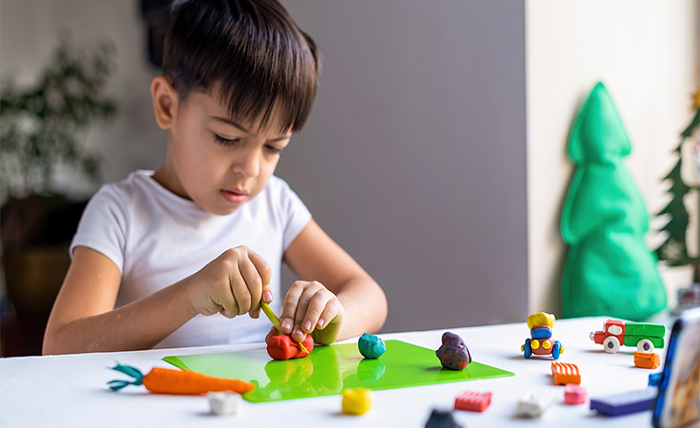
The preschool years are a time of rapid growth for the human brain. During this period, children are not just learning facts. They are building the foundational skills they will use to think, learn, and solve problems for the rest of their lives. Cognitive development refers to how children process information, remember things, and make decisions. While formal education plays a role, the home environment is where much of this critical development happens. Parents can support this process through simple, everyday interactions that encourage curiosity and critical thinking.
The Importance of Interactive Play
Play is the primary way preschoolers learn about the world. It allows them to experiment, take risks, and understand cause and effect. Parents can boost cognitive growth by engaging in specific types of play that require thinking and planning.
Constructive Play
Building with blocks or connecting toys helps children understand spatial relationships and basic physics. When a tower falls, a child learns about gravity and balance. Encourage them to plan what they want to build before they start. Ask questions like, “How will you make sure the bridge is strong enough?” This prompts them to think critically about structure and design.
Imaginative Play
Role-playing games, such as playing “restaurant” or “doctor,” require high-level thinking skills. Children must hold a scenario in their mind, follow rules they have created, and act out complex social interactions. Join in their games and introduce new challenges. If you are playing “grocery store,” ask how much three apples cost. This weaves basic math concepts into a fun narrative.
Reading and Storytelling
Reading aloud is one of the most effective ways to build language skills and cognitive abilities. However, the way you read matters just as much as the frequency.
Active Reading
Instead of simply reading the words on the page, make the experience interactive. Pause often to ask open-ended questions. Ask your child to predict what will happen next or to explain why a character is feeling sad. This requires them to analyze the story and use clues to make inferences.
Storytelling Without Books
Encourage your child to create their own stories. This practice strengthens memory and narrative skills. You can start a story and ask them to finish it, or ask them to recount the events of their day in order. Sequencing events helps them understand the concept of time and logical progression.
Incorporating Math into Daily Routines
Math skills in preschool go beyond counting to ten. They involve understanding patterns, shapes, and measurement. You do not need worksheets to teach these concepts. They are easily integrated into household chores and daily activities.
Cooking and Sorting
The kitchen is a laboratory for cognitive development. Cooking involves measuring ingredients, which introduces concepts of volume and quantity. Ask your child to help you count the number of eggs needed or to sort vegetables by color. Laundry time also offers learning opportunities. Ask your child to pair socks or sort clothes by type. This activity reinforces classification skills, which are essential for logical thinking.
Recognizing Patterns
Patterns are everywhere in the home. Point out patterns on a rug, in a tiled floor, or on clothing. Ask your child to identify the pattern and predict what comes next. You can also create physical patterns using toys, such as arranging cars in a sequence of red-blue-red-blue. Understanding patterns is a precursor to algebraic thinking.
Establishing Consistent Routines
Predictability provides a safety net that allows children to focus on learning. When children know what to expect, they feel secure enough to explore and ask questions.
Structure and Time Management
Routines help children understand the passage of time and the sequence of events. Discuss the schedule for the day each morning. Use terms like “first,” “next,” and “last” to build their understanding of order. This structure helps them mentally prepare for transitions. Whether your child spends their day at home or attends a structured program for before and after school care, maintaining a consistent rhythm supports their ability to focus and regulate their emotions.
Fostering Curiosity and Problem Solving
Children are naturally curious. Parents can harness this curiosity to teach the scientific method: observation, hypothesis, and testing.
Answering “Why” Questions
Preschoolers are famous for asking “why.” Instead of giving a direct answer immediately, ask them what they think. Encourage them to observe the world to find the answer. If they ask why plants need water, look at a wilted plant versus a healthy one. This teaches them to look for evidence.
Allowing Struggle
It is tempting to jump in and fix a problem for a child, but struggling is a key part of learning. If a puzzle piece does not fit, give them time to figure it out. Offer verbal guidance rather than physical help. You might say, “I see you are trying to fit that piece there. Have you tried turning it?” This supports their independence and builds resilience.
Conclusion
Supporting cognitive development at home does not require expensive tools or a rigorous curriculum. It requires intentionality. By turning daily routines into learning opportunities and engaging in purposeful play, parents can build a strong intellectual foundation for their children. The goal is to create an environment where questions are encouraged, thinking is valued, and learning is seen as a natural part of life.