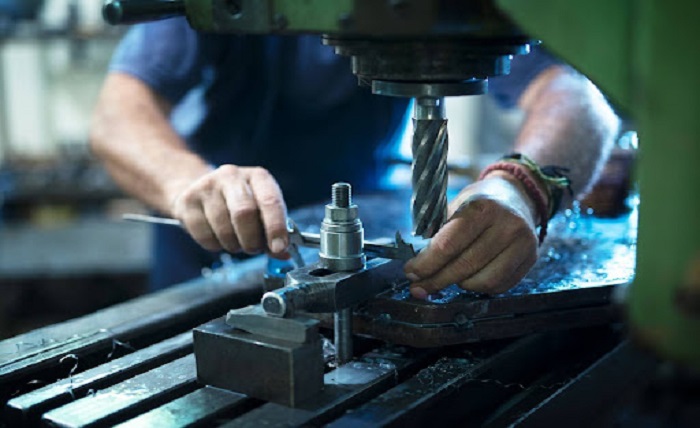
Many industries depend on parts that must fit perfectly and work without failure. Even a tiny error can affect safety, performance, or the life of a machine. This is why high-tolerance manufacturing is so important. One of the most trusted methods for this level of accuracy is CNC machining.
With computer-controlled tools, manufacturers can create parts with precise measurements and consistent quality. From aerospace and automotive to medical and industrial equipment, CNC machining helps produce reliable components.
In this blog, we will explore how CNC machining supports high-tolerance industrial applications and why it is essential for modern manufacturing.
Understanding Tolerance Requirements in Industrial CNC Applications
Walk into any modern machine shop, and you’ll witness standards that would’ve made manufacturers from thirty years ago shake their heads in disbelief. We’re talking about industrial CNC applications routinely hitting tolerances of ±0.0001″. Some cutting-edge facilities? They’re pushing even tighter.
Defining High-Tolerance Standards Across Industries
Let’s put this in perspective. Your typical machining job works comfortably within ±0.005″ tolerances, perfectly adequate for everyday parts. But when you step into high-tolerance territory, you’re looking at ±0.001″ or better. And that’s just the starting point.
Critical Tolerance Zones in Precision Manufacturing
You know what matters more than the actual dimension sometimes? The geometric relationships between features. That’s where GD&T, geometric dimensioning and tolerancing, comes into play.
Position accuracy, flatness, perpendicularity… These characteristics often trump basic size measurements. Then you’ve got surface finish requirements measured in Ra values that determine whether your part survives in high-friction or extreme-pressure environments.
Modern manufacturing facilities don’t put all their eggs in one basket. By integrating thermoforming services alongside CNC capabilities, smart manufacturers deliver comprehensive solutions that marry machining precision with forming efficiency for complete part production.
Core CNC Machining Technologies Enabling Microscopic Precision
Today’s CNC machines would look like alien technology to someone from the 1960s. We’ve got multi-axis systems, cutting-edge tooling, and measurement tech that works in real-time to deliver accuracy at microscopic levels.
Multi-Axis CNC Systems for Complex Tolerance Control
Five-axis simultaneous machining? Game changer. Instead of repositioning your part multiple times, each move stacking up potential errors, the workpiece stays put while your cutting tool attacks from every conceivable angle. Swiss-type CNC turning takes this further, delivering diameter tolerances within 0.0001″ on long, skinny shafts that’d bend like wet noodles under conventional turning.
Get this: modern equipment repeatability hits 0.00005″ on premium machines. That’s half a human hair’s width. Every single time.
Advanced Tooling Systems for High Tolerance Machining
Here’s something many people miss: even the world’s best CNC machine becomes useless with subpar tooling. Hydro-chuck and shrink-fit tool holders slash runout down to sub-micron levels, eliminating a massive source of dimensional variation. Polycrystalline diamond cutting tools maintain their edge geometry orders of magnitude longer than carbide, which means your thousandth part looks identical to your first.
Industrial CNC Applications Demanding Extreme Precision
The application spectrum runs from highly specialized aerospace components all the way to mass-produced consumer products, showcasing how CNC technology serves both niche and high-volume manufacturing worlds.
Aerospace and Defense Components
Turbine blades for commercial jet engines? They need ±0.0002″ tolerances because microscopic variations translate directly into fuel efficiency losses and shortened engine life. Landing gear components demand ±0.0005″ bearing fits to withstand brutal loads during takeoff and landing cycles. The stakes here aren’t just financial; they’re life and death.
Medical Device and Implant Manufacturing
Orthopedic implants require more than dimensional accuracy; you need biocompatible surface finishes measured in microinches. Hip and knee replacements must achieve precise fits to function properly for twenty to thirty years inside the human body. Surgical instruments demand ±0.0001″ cutting-edge tolerances for safe, reliable performance in operating rooms where there’s zero margin for error.
FDA validation doesn’t mess around. You need documented proof that your manufacturing process consistently delivers these tolerances across every production run.
Automotive Powertrain and Transmission Systems
Fuel injection nozzles operating above 30,000 PSI? They require bore tolerances of 0.0001″ for proper fuel atomization. Transmission gears meeting AGMA Class 12-13 specs demand precision machining to minimize noise while maximizing efficiency. Electric vehicle motor housings need tight tolerances, maintaining air gaps that directly impact motor performance and range.
CNC Machining Benefits for Tolerance-Critical Production
Understanding these advantages helps you make smarter decisions about production methods and where to invest your equipment budget.
Repeatability and Consistency Across Production Runs
The biggest CNC machining benefits? Eliminating human variability. Once you’ve validated your program, part number one thousand will match part number one within statistical process control limits. Process capability studies (Cpk) routinely exceed 1.67 for critical dimensions, translating to virtually zero defects in normal production.
Material Versatility Without Tolerance Compromise
Whether you’re cutting aluminum or wrestling with Inconel, modern CNC systems maintain tolerances through automatic temperature compensation and adaptive control algorithms. Difficult materials like titanium and Hastelloy that gave earlier equipment fits are now routinely machined to tight specs. Material-specific programming strategies optimize cutting parameters for each alloy’s unique behavior.
Challenges and Solutions in High Tolerance Machining
Real manufacturing environments face obstacles around cost, technical know-how, and maintenance requirements that directly impact precision production capabilities.
Tool Deflection and Chatter Mitigation
Long, slender cutting tools flex under cutting forces, creating dimensional errors. You combat this by calculating optimal tool stickout and deploying harmonic damping systems. Variable helix cutters break up harmonic frequencies, causing chatter, preserving both surface finish and dimensional accuracy.
Thermal Growth and Machine Warm-Up Protocols
Machine structures expand as they heat up, throwing off positioning accuracy. Proper spindle warm-up, typically thirty to sixty minutes, stabilizes temperatures before you cut critical features. Through-spindle coolant systems maintain thermal equilibrium during marathon production runs.
Wrapping Up High-Tolerance Manufacturing
Modern manufacturing’s dependence on microscopic precision has made CNC machining technology absolutely essential across countless industries. The combination of multi-axis systems, advanced tooling, and real-time measurement capability delivers tolerances that seemed like science fiction just a few decades back.
From life-saving medical devices to fuel-efficient turbine blades, high-tolerance machining enables technologies we count on every single day. Selecting manufacturing partners with proven precision capabilities isn’t just about checking specification boxes; it’s about guaranteeing product performance, ensuring safety, and securing long-term success in demanding applications where there’s no room for error.
FAQs on High-Tolerance CNC Work
- What is the tolerance of a CNC machine?
CNC machines are highly accurate, with some machines being able to produce parts to an accuracy of ± 0.0025mm. That’s the size of a quarter of a human hair. However, the tolerances of different CNC machines vary and are usually specified by the manufacturer; for example, 0.02mm is a typical average tolerance.
- How does temperature affect machining tolerances?
Temperature fluctuations cause both materials and machines to expand or contract. A mere 10°F temperature swing can generate 0.001″ dimensional changes in steel components. Climate-controlled facilities maintaining 68°F ±1°F eliminate this variable entirely.
- What industries require the tightest tolerances?
Aerospace leads the pack with ±0.0001″ requirements for flight-critical components, with medical implant manufacturing running a close second. Semiconductor equipment manufacturing often pushes even tighter specifications for vacuum chambers and precision positioning stages.