To Short or Too Short? Grammar Explained (With Examples)

To Short or Too Short? Grammar Explained (With Examples)

Have you ever typed a sentence and paused, wondering if you should write “to short” or “too short”? You’re not alone.

This common grammar mistake trips up even experienced writers, leaving them second-guessing their word choice at the worst possible moments.

Picture this: Sarah is writing an important email to her boss about why her presentation slides are too short for the upcoming meeting. She types “The slides are to short for our 30-minute presentation” and hits send.

Later, she realizes her mistake and cringes, knowing that grammar errors can undermine her professional credibility.

In their articles, Barb Carter covers the effects of seemingly small errors like this on a person’s career.

This seemingly simple choice between “to” and “too” represents one of the most frequent homophones confusion issues in English writing.

The consequences extend far beyond embarrassment – incorrect word usage can change your message’s meaning entirely and impact how readers perceive your expertise.

The Real Meaning Behind “Too Short”

Understanding the correct usage of “too short” starts with recognizing what this phrase actually means. “Too short” indicates that something is excessively brief or insufficient in length, duration, or extent.

The word “too” functions as an adverb that modifies adjectives to express excess or an undesirable degree.

When combined with “short,” it creates a descriptive phrase that signals inadequacy or insufficiency.

Consider these real-world examples:

  • Maria’s dress was too short for the formal dinner party
  • The movie felt too short – we wanted to see more character development
  • His explanation was too short to help us understand the complex process
  • The vacation seemed too short after months of planning

In each case, “too short” communicates that the length, duration, or extent falls below expectations or requirements.

Why “To Short” is Always Wrong

The phrase “to short” is grammatically incorrect in standard English. The word “to” serves as either a preposition or part of an infinitive verb construction, but it cannot function as a modifier for adjectives like “short.”

Here’s why this matters:

“To” as a preposition shows direction, purpose, or relationship:

  • I’m going to the store
  • Give this to Michael
  • The key to success is persistence

“To” in infinitive constructions precedes the base form of verbs:

  • I want to learn Spanish
  • She decided to call her grandmother
  • They need to finish the project

Neither function allows “to” to modify adjectives, making “to short” a fundamental grammar error that disrupts sentence structure and confuses readers.

Grammar Rules That Make the Difference

Understanding the grammatical distinction between “to” and “too” requires recognizing their different parts of speech and functions in English sentence structure.

The “Too” Rule

“Too” functions as an adverb with two primary meanings:

  1. Excessive degree: indicating something is more than necessary or desirable
  2. Addition: meaning “also” or “as well”

The “To” Rule

“To” operates as:

  1. A preposition showing direction, purpose, or relationship
  2. Part of infinitive verbs (to + base verb form)
Word Part of Speech Function Example
Too Adverb Shows excess The coffee is too hot
Too Adverb Means “also” I’m coming too
To Preposition Shows direction Walking to school
To Infinitive marker Forms infinitive I want to help


Also Read: Is it Witness’ or Witness’s or Witness? A Simple Guide


Real-Life Examples in Different Contexts

Professional writing often requires precise word choice, making the “too short” vs. “to short” distinction crucial for effective communication.

Business Communication Examples

  • The quarterly report was too short – investors need more detailed analysis
  • Our presentation time is too short to cover all key points effectively
  • The contract terms seem too short for such a complex project

Academic Writing Examples

  • The essay introduction feels too short for a 3,000-word paper
  • The research study period was too short to draw meaningful conclusions
  • Student responses were too short to demonstrate understanding

Everyday Conversation Examples

  • This line at the grocery store is too short – something must be wrong
  • My lunch break is too short to run errands
  • The movie trailer was too short to show the plot

Breaking Down Common Homophone Confusion

Homophones – words that sound identical but have different meanings and spellings – create significant challenges for writers. The “to/too/two” trio represents one of English’s most problematic phonetic confusion patterns.

Why This Confusion Happens

Identical pronunciation makes it impossible to distinguish these words by sound alone. Writers must rely on:

  • Contextual understanding
  • Grammatical knowledge
  • Spelling awareness
  • Meaning recognition

The Spell-Check Problem

Modern spell-check software cannot always catch homophone errors because “to short” contains two correctly spelled words. This means writers must develop manual proofreading skills to catch these mistakes.

Memory Tricks That Actually Work

Developing reliable memory techniques helps writers choose correctly between “to” and “too” in real-time writing situations.

The “Extra O” Method

Remember that “too” means “too much” or “extra” – both concepts requiring something additional. The extra “o” in “too” represents that excess.

The Substitution Test

Replace “too” with “excessively” or “very” in your sentence:

  • The presentation was too short → The presentation was excessively short ✓
  • The presentation was to short → The presentation was excessively short ✗

The Direction Test

If you can substitute “toward” or “in the direction of,” use “to”:

  • I’m going to the meeting → I’m going toward the meeting ✓
  • The report is to brief → The report is toward brief ✗

Professional Writing Standards and Expectations

Grammatical accuracy directly impacts professional credibility and reader perception. Understanding proper usage conventions becomes especially important in formal contexts.

Impact on Professional Communication

Grammar mistakes in professional writing can:

  • Undermine your expertise perception
  • Distract from your message content
  • Reduce reader confidence in your abilities
  • Create barriers to effective communication

Best Practices for Error Prevention

Implement these proofreading strategies:

  • Read your writing aloud to catch awkward phrasing
  • Use the substitution tests mentioned above
  • Have colleagues review important documents
  • Develop systematic editing routines

Advanced Usage Scenarios

Beyond basic “too short” applications, this grammar rule applies to numerous complex sentence structures and professional contexts.

Comparative Constructions

  • The deadline is too short compared to the project scope
  • Her answer was too short relative to the question’s complexity
  • The budget seems too short given current market conditions

Conditional Statements

  • If the presentation is too short, we’ll need additional content
  • Should the meeting prove too short, we’ll schedule a follow-up
  • When explanations are too short, confusion often results
 

to short


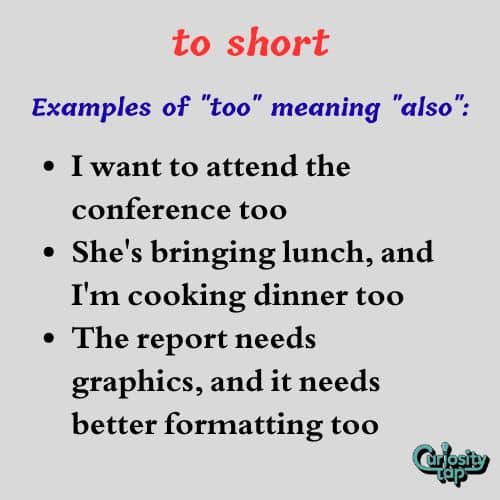
Bonus Tip: The “Also” Exception

Here’s a surprising insight that many writers miss: “too” can mean “also” or “as well,” creating additional usage opportunities beyond the excess meaning.

Examples of “too” meaning “also”:

  • I want to attend the conference too
  • She’s bringing lunch, and I’m cooking dinner too
  • The report needs graphics, and it needs better formatting too

This dual meaning makes “too” more versatile than many writers realize, but it never changes the fact that “to short” remains incorrect in all contexts.

What to Do and What to Avoid

✅ Do This:

  • Use “too short” when describing insufficient length or duration
  • Apply the substitution test with “excessively” or “very”
  • Proofread specifically for homophone errors
  • Practice with real-world examples until the distinction becomes automatic

❌ Avoid This:

  • Never write “to short” – it’s always grammatically incorrect
  • Don’t rely solely on spell-check for homophone detection
  • Avoid rushing through the editing process
  • Don’t ignore the importance of contextual grammar understanding

Expert Recommendation:

Develop a systematic approach to homophone checking. When you encounter “to/too” decisions, pause and identify whether you need a preposition, infinitive marker, or adverb. This conscious decision-making process will eventually become intuitive with practice.

Frequently Asked Questions

What’s the difference between “to” and “too” in simple terms?

“To” is a preposition showing direction (going to school) or part of infinitive verbs (to learn). “Too” is an adverb meaning “excessively” (too hot) or “also” (me too). The key difference lies in their grammatical function and meaning.

Is “too short” always grammatically correct?

Yes, “too short” is always grammatically correct when describing something that’s excessively brief or insufficient in length. It follows proper English grammar rules with “too” functioning as an adverb modifying the adjective “short.”

How can I remember when to use “too” instead of “to”?

Use the “extra O” memory trick – “too” has an extra “o” because it means “too much” or “extra.” You can also substitute “too” with “excessively” in your sentence. If it makes sense, use “too.” If not, you probably need “to.”

Why do spell-checkers miss “to short” errors?

Spell-check software focuses on individual word spelling rather than contextual grammar. Since both “to” and “short” are correctly spelled words, the program doesn’t recognize that their combination creates a grammar error. This makes manual proofreading essential for catching homophone mistakes.

Conclusion

Mastering the “too short” vs. “to short” distinction isn’t just about avoiding embarrassing typos – it’s about commanding respect through precise communication.

Every time you correctly choose “too short” over the incorrect “to short,” you’re demonstrating your attention to detail and grammatical expertise that sets you apart in both professional and personal writing.

Remember Sarah from our opening story? She now double-checks her homophone usage and has become the go-to person for proofreading important documents at her company.

The beauty of this grammar rule lies in its simplicity: “too” shows excess, “to” shows direction or forms infinitives, and “to short” simply doesn’t exist in proper English. With the memory tricks and substitution tests you’ve learned today, you’ll never again hesitate when choosing between these commonly confused words – and your readers will notice the difference.

Read more knowledgeable blogs on Curiosity Tap

Leave a Comment

Your email address will not be published. Required fields are marked *

Ritme Putaran Mahjong Ways Menuntut Konsentrasi agar Sesi Permainan Tetap TerkontrolPengamatan Visual Mahjong Ways Membantu Membedakan Perubahan pada Setiap PutaranBatas Waktu Bermain Mahjong Ways Membantu Membangun Disiplin selama Sesi PermainanRiwayat Mahjong Ways Membantu Memberikan Gambaran Lebih Objektif tentang Aktivitas BermainVariasi Tampilan Mahjong Ways Memengaruhi Cara Pemain Memahami Pengalaman PermainanPola Mahjong Ways Perlu Diamati tanpa Menganggap Hasil Sebelumnya sebagai PrediksiProbabilitas Mahjong Ways Menjelaskan Mengapa Hasil Putaran Tidak Harus BerulangDinamika Simbol Mahjong Ways Menunjukkan Perbedaan Susunan pada Setiap Rangkaian PutaranPengendalian Emosi Membantu Pemain Menentukan Waktu Berhenti dalam Sesi Mahjong WaysTiga Game Bertema Mahjong Menawarkan Karakter Visual dan Mekanisme yang BerbedaPersiapan Sebelum Bermain Mahjong Ways PG Soft Membentuk Kebiasaan Pengguna sejak Awal SesiMahjong Ways PG Soft Memadukan Tema Tradisional dengan Animasi Digital ModernKetidakpastian Hasil Mahjong Mendorong Rasa Penasaran Pemain pada Setiap SesiFitur Pengganda Mahjong Ways PG Soft Berperan Penting dalam Mekanisme PermainanMahjong Ways dan Mahjong Ways 2 Memicu Perdebatan tentang Persepsi Pola Gacor PemainMahasiswa Menelusuri Fakta Permainan Mahjong dari Rasa Tidak Peduli hingga Ingin TahuMahjong Ways Menonjolkan Simbol Ubin, Gates of Gatot Kaca Mengangkat Tema MitologiPerbedaan Teknologi dalam Mahjong Ways dan Mahjong Ways 2 yang Mempengaruhi Pengalaman PemainMahjong Ways dan Gates of Gatot Kaca 1000 Ramai Dibahas Penggemar Game Digital JakartaObrolan Angkringan Menggambarkan Cara Pemain Membahas Pengalaman Mahjong PG SoftDetail Mahjong yang Sering Terabaikan saat Pemain Terlalu Fokus pada HasilCerita Pedagang Gorengan Menggambarkan Istilah Mahjong PG Soft yang Sering Dibicarakan PelangganSimbol Beruntun Mahjong Ways Menjelaskan Alur Pergantian Simbol antar PutaranWarisan Mahjong Tradisional Terlihat pada Bentuk Ubin dan Identitas Visual Mahjong WaysUbin Mahjong Berawal dari Tradisi Tiongkok hingga Menginspirasi Desain Game ModernPak RT Mengisi Waktu Luang dengan Mengamati Susunan dan Runtuhan Simbol MahjongScatter Hitam Mahjong Wins Super Scatter Ramai Dibahas karena Pengganda hingga x100.000Mahjong Ways dan Mahjong Wins 2 Memiliki Mekanisme Berbeda meski Mengusung Tema UbinScatter Biru Mahjong Ways Ramai di FYP seiring Penyebaran Cuplikan PermainanFOMO Pemain Meningkat saat Hujan Scatter Mahjong Ways 1 dan 2 Ramai DibicarakanPengenalan Simbol Mahjong PG Soft Menguji Ketelitian terhadap Detail Visual PermainanMultiplier x100 Mafia Mayhem Berbeda dari Sistem Pengganda pada Mahjong Ways 2Bonus Akhir Tahun Mahjong Ways PG Soft Perlu Diperiksa melalui Ketentuan ResmiTiga Unsur Mahjong Ways PG Soft yang Membentuk Preferensi dan Pengalaman PemainMitos Scatter Hitam Mahjong Ways Berbeda dari Mekanisme Acak dalam PermainanCerita Tiga Scatter Hitam Memicu FOMO dalam Percakapan Antar PemainMahjong Ways dan Gatot Kaca Super Scatter Menonjol melalui Identitas Permainan BerbedaTradisi Mahjong Menginspirasi Perkembangan Game PG Soft menuju Hiburan Digital ModernPopularitas Mahjong PG Soft Mendorong Perhatian pada Cara Pemain Memaknai PengalamanAdaptasi Mahjong ke Format Digital Mengubah Unsur Tradisional menjadi Pengalaman di LayarDesain Mahjong PG Soft Berkembang melalui Detail Grafis yang Membentuk Identitas PermainanIdentitas Budaya Mahjong PG Soft Terlihat melalui Ornamen dan Simbol Khas AsiaMahjong PG Soft Kembali Menarik Perhatian dalam Siklus Tren Game DigitalTeknologi Animasi Mengubah Ubin Mahjong Tradisional menjadi Pengalaman Visual yang Lebih DinamisMenggali Kebiasaan Pemain dalam Menyusun Strategi di Mahjong PG SoftMahjong PG Soft Kini Dikenal Pengguna melalui Lebih Banyak Kanal DigitalSmartphone Memperluas Cara Pengguna Mengenal dan Mengakses Mahjong WaysKomunitas Digital Membentuk Beragam Pandangan tentang Mahjong Ways berdasarkan Pengalaman PenggunaKebiasaan Pengguna Mobile Mengubah Waktu dan Tempat Menikmati Mahjong WaysForum Online Menjadi Ruang Diskusi Mahjong Ways bagi Beragam Kelompok PenggunaRutinitas Sebelum Bermain Menunjukkan Perbedaan Persiapan Pengguna Game PG SoftMahjong Treasures Menawarkan Identitas Tema Tersendiri dalam Katalog PG SoftPilihan Game PG Soft Membentuk Cara Pemain Baru Menjelajahi Beragam Kategori PermainanGangguan Aktivitas Harian Dapat Menjadi Tanda Kebiasaan Judi Online Mulai BermasalahJudi Online Dapat Memengaruhi Hubungan Keluarga melalui Tekanan Finansial dan Perubahan KomunikasiMahjong Ways Berkembang Seiring Pertumbuhan Tren Game Digital Berbasis InternetRumus Mahjong Ways yang Beredar Perlu Dinilai berdasarkan Prinsip Keacakan PermainanRagam Game Mahjong PG Soft Menunjukkan Perkembangan Konsep dalam Satu Tema PermainanFortune Gods Menggunakan Unsur Mitologi untuk Membentuk Identitas Visual Permainan PG SoftAnalisis Cara Kerja Simbol Mahjong Ways dalam Setiap Putaran Permainan
Tiga Fakta Scatter Mahjong Ways PG Soft untuk Memahami Fungsi dan Mekanisme KemunculannyaKabar Pemuda Bogor Mendapat Tiga Scatter Memicu Pembahasan Fenomena Scatter Hitam Mahjong WaysMekanisme Multiplier Mahjong Ways Menyimpan Detail Perhitungan yang Belum Tentu Dipahami Pemain BerpengalamanMahjong Ways 1 dan Mahjong Ways 2 Bersaing Menarik Perhatian Pemain Medan melalui Perbedaan FiturKabar Pembelian iPhone 18 Pro Max dari Hasil Permainan Mahjong Ways 2 dan Gates of Olympus Menjadi PerbincanganCerita Gacor Mahjong Ways dalam Komunitas Memperlihatkan Kesenjangan antara Pengalaman Pribadi dan Hasil AcakKisah Karyawan Kebab di Solo Menjadi Pemilik Usaha Berkat Mahjong Ways Masih Memerlukan PembuktianSistem RNG Mahjong Ways Menjelaskan Mengapa Pola Putaran Sebelumnya Tidak Menjamin Hasil BerikutnyaEfek Dramatis Mahjong Ways Memanfaatkan Teknik Animasi untuk Membangun Ketegangan Visual Selama PermainanEvolusi Tampilan Mahjong Ways Mencerminkan Perkembangan Grafis dan Penyajian Simbol dalam Game DigitalPerubahan RTP Aktif Sering Diamati Pemain untuk Menentukan Waktu Bermain secara Lebih TerukurModal Kecil Mendorong Pemain Lebih Cermat Mengatur Durasi dan Intensitas Permainan SlotPencarian Maxwin Mendorong Pemain Menggabungkan Pemantauan RTP dengan Evaluasi Hasil PermainanLive RTP Berfungsi sebagai Data Referensi bukan Jaminan Hasil dalam Game OnlineData RTP Aktif Semakin Sering Dipakai untuk Menyesuaikan Pendekatan Bermain secara FleksibelPengelolaan Modal Kecil Menjadi Kunci Menjaga Durasi Bermain Slot Tetap TerkendaliKombinasi Spin Manual dan Turbo Menciptakan Pola Ritme Bermain yang Lebih VariatifEvaluasi Data dan Perubahan RTP Membentuk Cara Pemain Membaca Ritme Permainan SlotHubungan Pola Gacor dan Waktu Bermain Lebih Banyak Dipengaruhi Persepsi serta Variasi HasilMonitoring RTP Aktif Mendorong Pemain Menyusun Momentum Bermain Berdasarkan Data TerkiniDi Tengah Hujan Deras Bogor, Cerita Kemenangan Mahjong Ways Menjadi Perbincangan Komunitas PemainJejak Aktivitas Internet Harian Mengungkap Pergeseran Kebiasaan Pengguna dalam Mengonsumsi Konten DigitalSistem Analitik Modern Mengidentifikasi Pola Aktivitas Pengguna melalui Pengolahan Data Interaksi Secara TerstrukturPersonalisasi Hiburan Digital Berkembang melalui Teknologi yang Menyesuaikan Konten Berdasarkan Preferensi PenggunaAnalisis Data Platform Digital Membantu Mengidentifikasi Perubahan Penggunaan Layanan dari Waktu ke WaktuRespons Fisik Pemain Mahjong Ways Ditinjau melalui Hubungan Animasi, Efek Suara, dan Embodied CognitionSimulasi Putaran Digital Digunakan untuk Mengamati Variasi Respons Sistem pada Fase Permainan BerbedaKompleksitas Infrastruktur Mahjong Wilds Ditinjau melalui Perkembangan Teknologi Pendukung Fitur InteraktifPengelolaan Data Mahjong Wilds Menyoroti Peran Infrastruktur dalam Menjaga Kelancaran Operasional SistemPsikologi Pengguna Internet Mengungkap Hubungan antara Perubahan Kebiasaan Digital dan Respons EmosionalPergeseran Tren Game Memengaruhi Informasi yang Dicari Pemain Sebelum Memulai Aktivitas BermainAlgoritma Mahjong Ways dan Prinsip Keacakan Menjelaskan Batas Kemampuan Memprediksi Hasil PutaranPemanfaatan Data Perilaku Pengguna Memperluas Metode Penelitian tentang Dinamika Industri Hiburan DigitalKeputusan Pengembangan Platform Kini Memanfaatkan Temuan Analitik untuk Menentukan Prioritas Inovasi TeknologiInteraksi Digital Lintas Negara Mengalami Pergeseran Seiring Perluasan Infrastruktur dan Konektivitas GlobalKecepatan Respons Platform Digital Menjadi Indikator Penting dalam Evaluasi Kualitas Pengalaman PenggunaObservasi Aktivitas Mahjong Ways Dapat Digunakan untuk Mengkaji Durasi Sesi dan Kebiasaan PemainKarakter Volatilitas Mahjong Wild Deluxe, Sicbo, dan Gates Ditinjau melalui Perbedaan Distribusi Hasil PermainanEvaluasi RTP pada Permainan Digital Menjelaskan Perhitungan Pengembalian Teoretis tanpa Mengasumsikan Nilainya Berubah AdaptifSimbol Naga dalam Mahjong Menyimpan Jejak Budaya dan Makna Visual yang KuatPola Gacor Berkembang sebagai Topik Populer di Tengah Pertumbuhan Permainan DigitalRitme Permainan dan Besaran Modal Mempengaruhi Cara Pemain Menentukan Pola BermainData RTP dan Statistik Membentuk Pendekatan Strategis Baru dalam Permainan Game OnlineEvaluasi Data Membantu Pemain Menyusun Pendekatan Bermain secara Lebih TerukurKarakteristik Game Menentukan Cara Pemain Menyesuaikan Penggunaan Spin Manual dan TurboLive RTP dan Pola Gacor Semakin Sering Dijadikan Bahan Pertimbangan PemainPerubahan RTP Aktif Sering Diamati untuk Membaca Momentum dan Ritme PermainanWaktu Bermain Kini Lebih Sering Dikaitkan dengan Perubahan Pola serta Tempo PermainanPerilaku Pemain Berubah saat Monitoring RTP Aktif Mulai Masuk dalam Penyusunan StrategiModal Receh Menjadi Pendekatan Fleksibel untuk Mengatur Intensitas Bermain Game OnlineSpin Manual dan Turbo Menjadi Pilihan untuk Menyesuaikan Ritme Bermain Game OnlineNominal Permainan Sering Disesuaikan dengan Karakter Game dan Pergerakan RTP AktifPembacaan Data RTP Semakin Menjadi Bagian dari Kebiasaan Pemain Game OnlineMaxwin Kerap Dianalisis melalui Kombinasi Momentum Data dan Pola Permainan PemainStatistik dan RTP Live Membantu Pemain Membaca Pola Permainan secara Lebih ObjektifModal Receh Semakin Populer karena Memberi Ruang Bermain Lebih Fleksibel bagi Pemain HarianWaktu Bermain Sering Disesuaikan dengan Ritme Permainan dan Strategi yang DigunakanEvaluasi Data dan Monitoring RTP Aktif Membentuk Pendekatan Bermain yang Lebih SistematisSpin Manual Turbo dan RTP Aktif Sering Dikombinasikan dalam Strategi Bermain ModernLive RTP Menjadi Referensi Awal bagi Pemain sebelum Menentukan Pendekatan BermainAnalitik Interaksi Mengolah Aktivitas Pemain untuk Pengembangan Fitur DigitalArsitektur Kasino Digital Mahjong Menghubungkan Modul Permainan secara FleksibelBuffering Live Casino Menjaga Kelancaran Tayangan saat Jaringan BerubahEksplorasi Spatial Computing Memperluas Interaksi Game melalui Ruang DigitalGates of Olympus Memanfaatkan WebGPU untuk Efisiensi Pemrosesan GrafisImmersive Audio Memperkuat Pengalaman Permainan melalui Suara Tiga DimensiKasino Online Memanfaatkan Cloud Computing untuk Skalabilitas Layanan MobileKasino Online Memanfaatkan Containerization untuk Distribusi Layanan DigitalKolaborasi Pragmatic Play dan PG Soft Mengembangkan Teknologi MultiplatformKomposisi Sweet Bonanza 1000 Mengatur Kepadatan Visual pada SmartphoneLive Casino Memanfaatkan WebRTC untuk Komunikasi Interaktif Berlatensi RendahLucky Neko Memanfaatkan Adaptive Layout pada Berbagai Orientasi LayarMahjong Kasino Digital Memanfaatkan Sinkronisasi Cloud untuk Data PermainanMahjong Ways 2 Memanfaatkan WebGL untuk Penyajian Grafis ResponsifMahjong Wins 2 Memanfaatkan Preloading untuk Mempercepat Penyajian KontenMahjong Wins 3 Memanfaatkan Cloud Rendering untuk Grafis MobileMetodelogi Pengujian Gestur Menilai Akurasi Kontrol pada Layar SentuhModernisasi Platform Permainan Mengintegrasikan Teknologi Cloud dengan Antarmuka ResponsifObservasi Media Imersif Mengkaji Respons Pemain terhadap Teknologi InteraktifOptimalisasi Mahjong Ways 2 Mengurangi Latensi Respons pada Layar SentuhEksplorasi WebGPU Meningkatkan Pemrosesan Grafis dalam Game Berbasis BrowserEvolusi Game Digital Menggabungkan Teknologi Cloud dengan Media InteraktifGame Online Mengembangkan Koneksi Responsif untuk Interaksi MultiplatformGates of Olympus Mengintegrasikan Efek Visual dengan Kontrol MultisentuhImplementasi Mahjong Wins 3 Menghubungkan Fitur Mobile dengan Layanan CloudInterpretasi RTP dan Kasino Online Menyederhanakan Informasi pada MobileKasino Digital Mahjong Mengembangkan Infrastruktur Interaktif untuk Platform MobileKasino Online Mengembangkan Personalisasi Antarmuka berdasarkan Aktivitas PenggunaKasino Online Mengintegrasikan Teknologi Cloud dengan Antarmuka Mobile ResponsifKolaborasi Pragmatic Play dan PG Soft Menghubungkan Platform InteraktifKonfigurasi Mahjong Wins 2 Menyesuaikan Kualitas Tampilan berdasarkan PerangkatLive Casino Mengembangkan Streaming Interaktif dengan Respons Lebih CepatLucky Neko Mengembangkan Kontrol Sentuh dengan Navigasi Lebih IntuitifMahjong Kasino Digital Mengadopsi Arsitektur Cloud untuk Layanan MobileMahjong Ways 2 Mengembangkan Mekanisme Sentuh untuk Interaksi MobileMahjong Wins 2 Mengintegrasikan Animasi Dinamis dengan Kontrol MobileMahjong Wins 3 Mengembangkan Kontrol Responsif untuk Pengalaman MultisentuhMetode Progressive Loading Mempercepat Akses Konten pada Game MobileMigrasi Kasino Online Mengalihkan Infrastruktur menuju Sistem Cloud-NativeMikrointeraksi Visual Memberikan Respons Instan terhadap Aksi Pengguna Mobile
Scroll to Top